

Smart Campaign Optimization
CASE STUDY PREVIEW & SUMMARY
- Context: An optimization study evaluating the structural performance data of approximately 200,000 multi-channel marketing campaigns across a continuous two-year operations timeline.
- The Challenge: Pinpointing the exact factors driving differences in Return on Investment (ROI) and identifying whether efficiency bottlenecks stem from distribution channels, demographic targeting, or campaign-level execution.
- Key Findings: Marketing performance is remarkably uniform across channel selections and audience segments. Instead, outcomes are driven primarily by campaign-level execution—such as creative quality, messaging alignment, and post-click conversion strategies.
Project Background & Business Objective
Modern marketing optimization often relies on shifting ad spend across distribution channels and demographic cohorts. However, without data-backed validation, these budget adjustments can become a distraction from the real performance drivers. The goal of this comprehensive analysis was to evaluate an enterprise dataset containing roughly 200,000 records tracking marketing performance over two years. By breaking down performance along three major axes—Click-Through Rate (CTR) as an engagement metric, conversion rate as an operational efficiency index, and ROI as a bottom-line metric—the study separates channel performance from execution variables to help stakeholders optimize marketing budget allocation.
Advanced Methodology & Metric Modeling
To build a reliable dataset for segmentation, standard missing fields were addressed, and derived metrics were calculated using industry-standard marketing frameworks:
- Click-Through Rate (CTR): Calculated as total recorded clicks divided by gross ad impressions (Clicks/Impressions).
- Volumetric Conversions: Derived by multiplying total clicks by the campaign’s recorded conversion rate (Clicks x Conversion Rate).
- Gross Total Cost: Modeled by multiplying total conversions by customer acquisition costs (Conversions x Acquisition Cost).
- Revenue Generation: Back-calculated directly from documented baseline Return on Investment (ROI) figures.
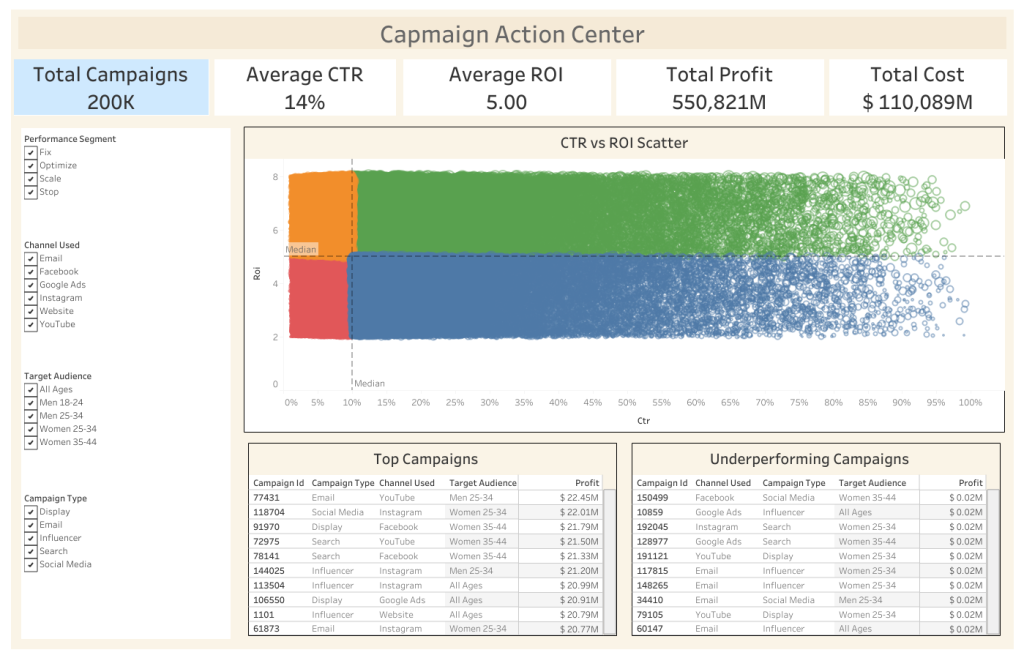
Following feature engineering, individual campaigns were mapped into four performance quadrants using median CTR and baseline ROI as division thresholds to break down execution efficiency.
Strategic Performance Insights
The performance quadrants revealed critical, non-obvious operational realities:
- The Hidden High-Efficiency Quadrant (25% of Campaigns): Approximately one-quarter of all analyzed campaigns exhibit lower-than-average click volume but exceptionally high baseline ROI. This trend proves that once a user engages, they convert at an excellent rate. Because this pattern is consistent across platforms, it highlights a prime scaling opportunity if messaging and creatives are improved to drive click volume.
- The Engagement vs. Value Misalignment (25% of Campaigns): Conversely, another 25% of campaigns demonstrate above-median engagement (CTR) but fall below the median ROI threshold. This indicates a structural failure to convert traffic into real business value. Increasing ad spend for these campaigns is counterproductive; instead, optimization must be focused entirely on post-click conversion funnels and closing strategies.
- Performance Consistency Across Channels and Audiences: Statistical analysis across distribution networks shows remarkable consistency. ROI, conversion rates, and acquisition costs vary minimally across platforms. No single network (e.g., YouTube, Facebook, Email) holds a fundamental advantage in efficiency. Similarly, demographic audience segments exhibit evenly balanced metrics, meaning that targeting shifts alone will not significantly move performance.
Operational Recommendations & Strategic Playbook
Based on the quantitative insights surfaced by the performance analysis, the following operational principles were introduced to guide corporate marketing strategy:
- Scale High-Performing Campaigns Immediately: Prioritize budget expansion for identified top-tier campaigns that show strong concurrent engagement and profitability, as they are best positioned to deliver incremental revenue.
- Optimize Creative Assets for High-Efficiency Frameworks: For low-CTR, high-ROI campaigns, update ad copies, write compelling headlines, and optimize visuals to scale click volume without compromising backend profitability.
- Re-engineer Conversion Paths for High-Traffic Campaigns: For high-click, low-return campaigns, freeze ad spend expansions and focus on the post-click experience, simplify checkout, and improve site experience.
- Discontinue Low-Performing Campaigns: Establish strict budget cut-offs for bottom-tier executions. If systematic optimization sprints fail to lift metrics, immediately discontinue the campaigns to prevent budget waste.
Conclusion
This study proves that shifting budgets between channels or demographic buckets is often a distraction from what matters most. Because baseline channel performance is highly uniform, marketing success is determined by campaign execution quality. Focusing on creative design, messaging clarity, and conversion strategy provides the highest statistical probability of increasing overall marketing efficiency and maximizing return on investment.